
Diabetic Foot Reconstruction Surgery: Restoring Function and Mobility
Diabetic foot reconstruction surgery is a specialized st of
surgical procedures designed to repair damaged tissue, restore foot structure, prevent amputation, and return mobility to diabetic patients with severe foot wounds or deformities. When performed by a qualified reconstructive surgeon, it offers many patients a genuine chance to save their limb and walk again.
When a Wound Becomes More Than a Wound
There is a moment in every complicated diabetic foot case when simple wound dressings are no longer enough. The wound is too deep, or the infection has spread too far, or the tissue is dead beyond the point of self-recovery.
This is the time when diabetic foot reconstruction surgery is not just an option, but a necessity.
For patients in Hisar, Fatehabad, Jind, and Hansi, understanding what this surgery involves, who needs it, and where to find the best diabetic foot surgery in Hisar can make the difference between walking out of a clinic on two feet — or not.
This is a complete, expert guide to diabetic foot reconstruction surgery: what it is, how it works, what results to expect, and why choosing the right reconstructive surgeon matters more than almost any other decision in a diabetic foot journey.
What Is Diabetic Foot Reconstruction Surgery?
Diabetic foot reconstruction surgery is not a single operation — it is a category of surgical interventions performed by specially trained plastic and reconstructive surgeons to:
- Remove dead or infected tissue (debridement)
- Restore blood supply to the foot
- Close large wounds that cannot heal on their own
- Correct structural deformities of the foot
- Prevent or minimize the extent of amputation
- Enable the patient to bear weight and walk again
The goal is limb salvage — preserving as much of the foot and leg as possible, restoring function, and giving the patient back their independence and mobility.
Diabetic foot reconstruction sits at the intersection of plastic surgery, vascular surgery, orthopaedics, and diabetes medicine. A truly comprehensive reconstructive approach requires a surgeon who understands all these dimensions — not just one.
Understanding the Problem: Why Diabetic Foot Gets So Severe
Before understanding the surgery, it helps to understand why diabetic foot progresses to the point of needing reconstruction at all.
The Two Underlying Mechanisms
Diabetic Neuropathy (Nerve Damage) Chronic high blood sugar destroys peripheral nerves over time. Patients lose the ability to feel pain, heat, and pressure in their feet. A small wound — from a shoe rubbing, a thorn, or stepping on something — goes completely unnoticed. It may be deep and already infected when it is seen.
Peripheral Arterial Disease (Poor Circulation) Diabetes damages blood vessels, dramatically reducing blood flow to the feet. Without adequate blood supply, even a minor wound cannot heal — the oxygen, nutrients, and immune cells that healing requires simply do not arrive in sufficient quantities.
These two mechanisms together create what specialists call the diabetic foot triad: a wound that the patient cannot feel, cannot fight infection against, and cannot heal without intervention.
How Diabetic Foot Progresses
| Stage | Condition | Surgical Need |
|---|---|---|
| 0 | High-risk foot; no open wound | Preventive foot care; specialist monitoring |
| 1 | Superficial ulcer | Wound care; debridement |
| 2 | Deep ulcer reaching tendon/capsule | Surgical debridement; advanced dressings |
| 3 | Deep ulcer with abscess or osteomyelitis | Major debridement; bone surgery |
| 4 | Localised gangrene (toe/forefoot) | Partial amputation + reconstruction |
| 5 | Extensive gangrene of whole foot | Major amputation; possible reconstruction |
The earlier surgery is performed, the more of the foot can be saved. Patients who seek care at Stage 1–2 have dramatically better outcomes than those who arrive at Stage 4–5.
What Is Diabetic Foot? A Brief Overview for Context
What is diabetic foot? It is the collective term for the foot complications that arise in 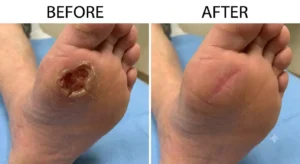 diabetic patients — primarily from diabetic neuropathy (nerve damage causing loss of sensation) and vascular disease (reduced blood flow). These conditions are associated with an extraordinary susceptibility to wounds, infection and impaired healing in the feet.
What is the importance of foot care for diabetics? Diabetic patients can’t use pain as a warning signal. Routine daily diabetic foot care is the first line of defence – but when it fails, reconstructive surgery may be the last line between patient and amputation.
Who Should Have Diabetic Foot Reconstruction Surgery?
Reconstruction is not needed in all patients with diabetic foot ulcers. But there are specific situations where surgery is unavoidable:
When: Typically Needs Surgery
- A wound that has not healed after 4-6 weeks of optimal medical management
- There is bone infection (osteomyelitis) — confirmed by imaging
- Gangrene (dead tissue) is present — either dry or wet
- An abscess requires drainage
- The wound is too large to close or heal without a skin graft or flap
- The foot has structural deformity (Charcot foot) causing repeated ulceration
- Partial amputation is needed, followed by reconstruction of the remaining foot
Early stage diabetic foot ulcers (superficial, no infection) rarely require major reconstruction. The need for surgical reconstruction typically arises from delayed presentation or rapidly progressive infection.
Types of Diabetic Foot Reconstruction Surgery
Diabetic foot reconstruction surgery encompasses several distinct procedures, often used in combination:
1. Surgical Debridement
The most fundamental reconstructive procedure. The surgeon removes all dead (necrotic), infected, and non-viable tissue from the wound. This is not the same as simple wound cleaning — it is aggressive removal of tissue that is harbouring bacteria and preventing healing.
Thorough debridement transforms a chronic, non-healing wound into an acute wound with the capacity to heal. It must be performed by an experienced surgeon, not at home or by non-surgical practitioners.
2. Skin Grafting
When a large wound cannot close on its own but the wound bed is clean and well-supplied with blood, a skin graft transplants thin sheets of skin from another part of the patient’s body (usually the thigh) to cover the wound.
Split-thickness skin grafting is the most common technique — taking the outer layers of skin from a donor site and applying them to the wound. When successful, grafts integrate within 5–7 days and provide durable coverage.
3. Flap Reconstruction
For deeper, larger, or more complex wounds — particularly those overlying bone, tendon, or joint — a simple skin graft is insufficient. These wounds require a flap: a block of tissue (skin, fat, and sometimes muscle) that is transferred to the wound while maintaining its own blood supply.
Flaps provide robust, well-vascularized tissue coverage that can withstand the pressures of weight-bearing. Types include:
- Local flaps — tissue moved from adjacent areas of the foot or lower leg
- Regional flaps — tissue from more distant leg areas
- Free flaps (microvascular surgery) — tissue from elsewhere in the body, reconnected via microsurgical blood vessel anastomosis
4. Microvascular Surgery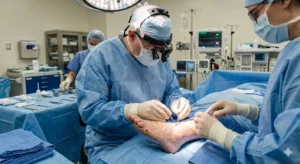
Microvascular surgery — surgery performed under high magnification using microscopes — allows surgeons to reconnect tiny blood vessels (less than 2mm in diameter). This technique enables free flap reconstruction, where tissue from the thigh, abdomen, or arm is transplanted to the foot with a complete new blood supply.
Microvascular surgery represents the highest level of reconstructive complexity and requires specific training and infrastructure — making the surgeon’s qualifications critically important.
5. Partial Amputation and Stump Reconstruction
Sometimes, a portion of the foot — a toe, part of the forefoot, or the heel — cannot be saved. In these cases, the reconstructive surgeon performs a partial amputation that preserves the maximum amount of viable foot tissue, then reconstructs the remaining stump to allow weight-bearing and, ultimately, normal or near-normal walking with appropriate diabetic footwear and orthotics.
Skilled partial amputation and reconstruction is a genuine limb salvage technique — preserving far more function than a below-knee amputation.
6. Bone and Joint Surgery (Charcot Foot Reconstruction)
Charcot foot is a devastating diabetic complication where the bones of the foot gradually collapse and fracture due to neuropathy, creating severe deformity. The resulting abnormal pressure points lead to chronic ulceration.
Charcot foot reconstruction involves surgical realignment and stabilization of the foot’s bone architecture — a complex procedure that requires both orthopaedic and plastic surgical expertise.
7. Vascular Revascularization
If blood supply is severely compromised, wound healing simply cannot occur regardless of how well the wound itself is managed. Vascular revascularisation, either by angioplasty (dilatation of stenotic vessels) or by bypass surgery (creation of new pathways for blood flow) is a prerequisite for reconstruction in ischaemic feet.
Hence the importance of a complete diabetic foot surgical approach, with a multi-disciplinary team including the plastic surgeon, a vascular surgeon and an endocrinologist working together.
Hyperbaric Oxygen Therapy: An Advanced Tool in Diabetic Foot Treatment
Hyperbaric oxygen therapy for diabetic foot wound plays an increasingly important role in complex diabetic foot management — both before and after reconstruction.
In a hyperbaric chamber, the patient breathes 100% pure oxygen at 2–3 times atmospheric pressure. This dramatically elevates the oxygen levels in tissues, providing several benefits:
- Kills anaerobic bacteria — the type most commonly found in deep diabetic wound infections
- Stimulates angiogenesis — formation of new blood vessels in the wound
- Enhances white blood cell function — improving the body’s ability to fight remaining infection
- Accelerates wound healing — in wounds that have not responded to standard treatment
Hyperbaric oxygen therapy is particularly valuable for diabetic foot wound healing in patients whose wounds are failing to progress despite good surgical management.
Limb Salvage: The Overarching Goal
Limb salvage treatment — the use of all available medical and surgical 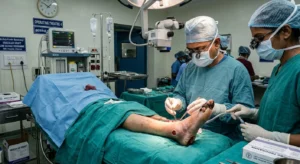 strategies to avoid amputation — is the philosophy that drives modern diabetic foot reconstruction surgery.
The statistics justify this aggressive approach:
- Major amputation (below-knee or above-knee) carries a 5-year mortality rate of 50–70% in diabetic patients
- Quality of life after major amputation is dramatically reduced
- Many patients who undergo major amputation never walk independently again
- Conversely, patients who achieve successful limb salvage — even with partial foot loss — typically regain functional mobility and meaningful independence
Foot amputation prevention through skilled reconstructive surgery is not just about saving a body part — it is about saving a life’s quality and, very often, the life itself.
The Diabetic Foot Reconstruction Surgery Journey: Step by Step
Phase 1: Comprehensive Assessment
The reconstructive surgeon performs a full evaluation including wound evaluation, vascular status (blood supply to the foot), neurological testing (degree of neuropathy), bone imaging ( X-ray, MRI for osteomyelitis ), blood sugar control evaluation, and nutritional status.
Reconstruction can’t work if you don’t know the whole picture of the patient’s condition.
Phase 2: Medical Optimization
Before surgery:
- Blood sugar is stabilized as much as possible
- Active infection is treated with targeted antibiotics
- Nutritional deficiencies are corrected
- Vascular status is addressed if necessary
Phase 3: Surgical Reconstruction
The appropriate reconstructive procedure — debridement, grafting, flap, partial amputation — is performed under anaesthesia. Complex cases may require staged procedures over several weeks.
Phase 4: Post-Surgical Wound Care
After reconstruction, meticulous wound care continues. Appropriate dressings, infection monitoring, and graft/flap viability checks are performed regularly during the early healing phase.
Phase 5: Rehabilitation and Offloading
As healing progresses, the patient is fitted with diabetic footwear, custom orthotics, and offloading devices. Physiotherapy helps restore strength, balance, and walking ability.
Phase 6: Long-Term Diabetic Foot Care
After successful reconstruction, the patient requires:
- Lifelong diabetic foot care — daily inspection, moisturising, footwear vigilance
- Regular specialist follow-up with a diabetic foot doctor in Hisar or their local specialist
- Continued glycaemic control
- Use of diabetic foot care products as advised
Diabetic Foot Surgery vs. Amputation: Understanding the Choice
| Factor | Reconstruction Surgery | Major Amputation |
|---|---|---|
| Goal | Save the limb and restore function | Remove the limb to control infection/gangrene |
| Recovery | Longer, but preserves mobility | Faster initially; long-term function loss |
| Walking ability | Often fully or partially restored | Requires prosthesis; reduced independence |
| Long-term survival | Better — amputation linked to high mortality | Higher short-term but poor long-term |
| Patient quality of life | Significantly better | Significantly reduced |
| When it’s the right choice | When limb is salvageable | When limb is beyond saving |
The right choice depends entirely on the individual patient’s condition — and requires expert surgical assessment. When limb salvage is possible, reconstruction is almost always the better outcome.
Expert Tips from Dr. Sandeep Chahar on Diabetic Foot Reconstruction
- Time is tissue — every day of delay in treating a diabetic foot infection is tissue lost that cannot be recovered
- Blood sugar control before surgery dramatically improves outcomes — poorly controlled diabetes prevents graft and flap survival
- Choose a surgeon with microvascular training — complex reconstructions require microsurgical capability; not all general surgeons have this
- Nutrition matters more than most patients realise — protein and micronutrient status are critical to wound healing and graft survival
- Post-operative footwear compliance is non-negotiable — reconstruction fails when patients return to inappropriate footwear
- Staged procedures are sometimes better — attempting everything in one operation may be less safe than staged, planned surgery
- Multidisciplinary care gives the best outcomes — the surgeon, diabetologist, vascular surgeon, and physiotherapist must work as a team
Common Mistakes That Worsen Diabetic Foot Outcomes
- Delaying presentation — the single most common and most devastating mistake in diabetic foot in India and diabetic foot in Hisar
- Applying home remedies to wounds — turmeric, spirit, herbs all delay healing and mask worsening infection
- Poorly controlled blood sugar during the recovery period — high glucose prevents graft and flap integration
- Non-compliance with offloading — walking on a reconstructed foot without protective diabetic footwear undoes the surgery
- Choosing a non-specialist — diabetic foot reconstruction surgery requires specific training; not all surgeons perform microsurgical flap reconstruction
- Stopping antibiotics early — incomplete antibiotic courses allow resistant bacteria to survive
Diabetic Foot Pain and Neuropathy: What Reconstruction Addresses
Diabetic foot pain in the context of neuropathy is paradoxical. Some patients experience burning, shooting pain from nerve damage; others feel nothing at all — which is more dangerous. Reconstruction does not cure diabetic neuropathy, but it:
- Removes the infected or necrotic tissue causing systemic inflammation and toxicity
- Restores a protective skin cover over vulnerable structures
- Corrects deformities that cause pressure-induced pain
- Reduces the risk of further ulceration and infection
Addressing diabetic foot pain through reconstruction is about removing the sources of damage, not replacing nerve function.
Diabetic Foot in India: Why Reconstructive Surgery Is Transforming Outcomes
Diabetic foot in India has historically been managed with a heavy bias toward amputation — particularly in smaller cities and towns — simply because reconstructive expertise was not locally available.
This is changing. As plastic and reconstructive surgeons with microsurgical training become established in cities like Hisar, patients who previously had no option but amputation are now achieving limb salvage through diabetic foot reconstruction surgery.
The results from Indian centres are encouraging: limb salvage rates of 70–85% in selected patients undergoing comprehensive reconstruction are increasingly being reported in peer-reviewed literature. Diabetic foot wound healing through reconstructive techniques is achieving outcomes that match international standards.
For patients across Haryana — searching for diabetic foot near me, or best diabetic foot surgeon in Hisar — the access to this level of care is closer than ever before.
Meet Dr. Sandeep Chahar — Best Diabetic Foot Surgeon in Hisar
Dr. Sandeep Chahar MBBS | DNB (General Surgery) | M.Ch. Plastic Surgery
Dr. Sandeep Chahar is among the most highly qualified best plastic surgeons for diabetic foot in Hisar, bringing M.Ch. Plastic Surgery expertise — the highest plastic surgical qualification in India — to every complex diabetic foot case he manages.
His background in Hand & Microvascular Surgery means he possesses the microsurgical skill set required for the most advanced free flap reconstructions — a capability that sets him apart from general surgeons and many cosmetic practitioners who offer wound management without reconstructive training.
Dr. Chahar’s Approach to Diabetic Foot Reconstruction:
- Comprehensive pre-surgical assessment — vascular, neurological, wound, and systemic evaluation
- Staged, patient-specific surgical planning — no one-size-fits-all approach
- Microsurgical capability — for complex free flap reconstructions when needed
- Multidisciplinary coordination — working alongside diabetologists and vascular surgeons
- Long-term follow-up — because reconstruction is the beginning of recovery, not the end
Patients travel to Dr. Chahar’s clinic from across Haryana — Hisar, Fatehabad, Jind, and Hansi — specifically because specialist reconstructive expertise of this level is not widely available in the region.
Other Specializations: Rhinoplasty, Gynecomastia Surgery, Liposuction, Hair Transplantation, GFC/PRP Therapy, Ear Reconstruction.
If you are searching for diabetic foot surgery in Hisar, diabetic foot near me, or the best diabetic foot surgeon in Hisar — Dr. Chahar’s clinic is where your search ends.
People Also Ask
Q: What is diabetic foot reconstruction surgery? It is a set of surgical procedures — including debridement, skin grafting, flap surgery, and microvascular reconstruction — performed to repair diabetic foot wounds, prevent amputation, and restore walking ability.
Q: Can diabetic foot be treated without amputation? Yes — in many cases, with skilled reconstructive surgery. Diabetic foot reconstruction surgery performed by an experienced specialist at the right time can help save limbs in most of the patients.
A: How long does it take to recover from diabetic foot reconstruction surgery? Recovery varies by procedure complexity. Simple debridement and grafting: 4–8 weeks. Complex flap reconstruction: 3–6 months with full rehabilitation. Charcot foot reconstruction may take 6–12 months.
Q: Is diabetic foot reconstruction surgery available in Hisar? Yes. Dr. Sandeep Chahar’s plastic surgery clinic in Hisar offers comprehensive diabetic foot reconstruction surgery, including advanced microsurgical techniques, serving patients from Hisar, Fatehabad, Jind, and Hansi.
Q: What are the risks of not treating diabetic foot surgically when needed? Without timely surgical intervention, diabetic foot infections spread rapidly to bone (osteomyelitis), cause gangrene, lead to major limb amputation, and can progress to life-threatening sepsis.
FAQ: Diabetic Foot Reconstruction Surgery
1. What is the difference between diabetic foot treatment and reconstruction surgery? Diabetic foot treatment covers the full spectrum from wound dressings and antibiotics to surgery. Reconstruction surgery is surgery that repairs tissue, restores the structure of the foot and heals wounds that are too complex to be treated without surgery.
2. Who should be considered for diabetic foot reconstruction surgery? Patients with large, deep, or non-healing diabetic foot wounds; those with gangrene limited to part of the foot; patients with osteomyelitis requiring bone removal; and those with Charcot foot deformity causing chronic ulceration.
3. How do I find a diabetic foot surgeon in Hisar? Dr. Sandeep Chahar’s plastic surgery clinic in Hisar specializes in diabetic foot reconstruction surgery. Patients from Hisar, Fatehabad, Jind, and Hansi regularly access specialist care at his clinic.
4. What is limb salvage treatment? Limb salvage treatment is the comprehensive medical and surgical approach aimed at preventing amputation in patients with severe diabetic foot complications — using all available tools from wound management and antibiotics to complex reconstruction and microvascular surgery.
5. Does diabetic foot reconstruction surgery require general anaesthesia? It depends on the procedure. Minor debridement may be performed under local or regional anaesthesia. Skin grafting and flap procedures typically require general or spinal anaesthesia. Your surgeon will advise based on your specific procedure and health status.
6. What is the role of microvascular surgery in diabetic foot reconstruction? Microvascular surgery enables free flap reconstruction — transplanting tissue from elsewhere in the body to cover large wounds on the foot. It requires highly specialized training and microscope-guided surgical technique, providing coverage options unavailable with simpler approaches.
7. Can I walk normally after diabetic foot reconstruction surgery? Many patients regain normal or near-normal walking ability after successful reconstruction, particularly following skin grafting or local flap procedures. More complex reconstructions or partial amputations may require custom diabetic footwear and orthotics for functional walking.
8. What diabetic foot care products are needed after reconstruction? Post-reconstruction, patients typically need: specialist diabetic footwear, custom insoles/orthotics, moisturizing foot cream, seamless diabetic socks, and a daily inspection routine. Your surgeon and rehabilitation team will provide a personalized list.
9. Is hyperbaric oxygen therapy used after diabetic foot reconstruction surgery? Yes. Hyperbaric oxygen therapy for diabetic foot wound is sometimes used post-operatively to improve graft or flap survival, reduce infection risk, and accelerate wound healing — particularly in complex or previously failed reconstructions.
10. What does diabetic foot reconstruction surgery cost in India? Costs vary significantly based on procedure complexity, duration of hospital stay, and the specific reconstruction required. Simple debridement and grafting may cost ₹40,000–₹1,00,000. Complex flap reconstruction may range from ₹1,50,000–₹4,00,000 or more. Contact Dr. Chahar’s clinic for a personalized estimate based on your case.
11. What happens if diabetic foot reconstruction surgery fails? If reconstruction fails — due to poor blood supply, uncontrolled infection, or non-compliance — revision surgery or, in the worst case, amputation may be required. This is why careful patient selection, pre-surgical optimization, and post-operative compliance are so critical.
12. How is diabetic foot surgery different from regular foot surgery? Diabetic foot surgery accounts for the impaired healing, infection risk, and vascular compromise specific to diabetic patients. It requires specialized surgical planning, more aggressive infection management, and careful attention to blood supply — factors not relevant in non-diabetic foot surgery.
Conclusion: Diabetic Foot Reconstruction Surgery Offers a Real Path Forward
The fear of amputation is one of the most powerful anxieties a diabetic patient can carry. Many do not realize—and this guide has tried to make clear—that diabetic foot reconstruction surgery has changed the outlook for patients with even severe foot problems.
Through technically advanced reconstructive surgery, microsurgical techniques and thorough diabetic foot care, limb salvage restores what uncontrolled infection and diabetes would otherwise take away – mobility, independence and quality of life.
Diabetic foot surgery in Hisar is not something far away, requiring you to travel to a distant city. We offer expert reconstructive care including advanced microsurgical techniques right here, for patients throughout Hisar, Fatehabad, Jind and Hansi.
If you or someone you love has a diabetic foot wound, infection or has been told that amputation may be necessary – get a specialist reconstructive opinion first. In most cases, there is a better way.
Talk to Dr. Sandeep Chahar – Best Diabetic Foot Surgeon in Hisar
📍 Plastic & Reconstructive Surgery Clinic, Hisar, Haryana 📞 Call or WhatsApp for urgent diabetic foot consultation 🌐 Serving Hisar, Fatehabad, Jind, Hansi & across Haryana
Dr. Sandeep Chahar – MBBS, DNB (General Surgery), M.Ch. Plastic Surgeon Specialist in Diabetic Foot Reconstruction, Microvascular Surgery & Limb Salvage
Every foot deserves a shot at being saved. Call today – before it is done for you.
20 SEO Hashtags
#DiabeticFootReconstruction #DiabeticFootSurgery #LimbSalvage #DiabeticFootHisar #FootReconstructionSurgery #MicrovascularSurgery #DiabeticFootIndia #PlasticSurgeonHisar #DrSandeepChahar #DiabeticFootTreatment #FootAmputationPrevention #DiabeticWoundHealing #DiabeticFootCare #DiabeticNeuropathy #ReconstructiveSurgeryIndia #DiabeticFootSurgeon #HyperbaricOxygenTherapy #DiabeticFootWound #BestDiabeticFootSurgeonHisar #PlasticSurgeryHisar
Disclaimer: This article is for informational and educational purposes only. It does not constitute medical advice. Please consult Dr. Sandeep Chahar or a qualified medical specialist for evaluation and treatment of diabetic foot conditions.
1 Comment
Diabetic Foot Treatment in Hisar
June 29, 2026[…] Diabetic Neuropathy (Nerve […]